Posted on

Freediving Intermediate-Advanced Course

BY: Valentina / 0 COMMENTS / CATEGORIES: Baja, Course, Freediving, Freefall

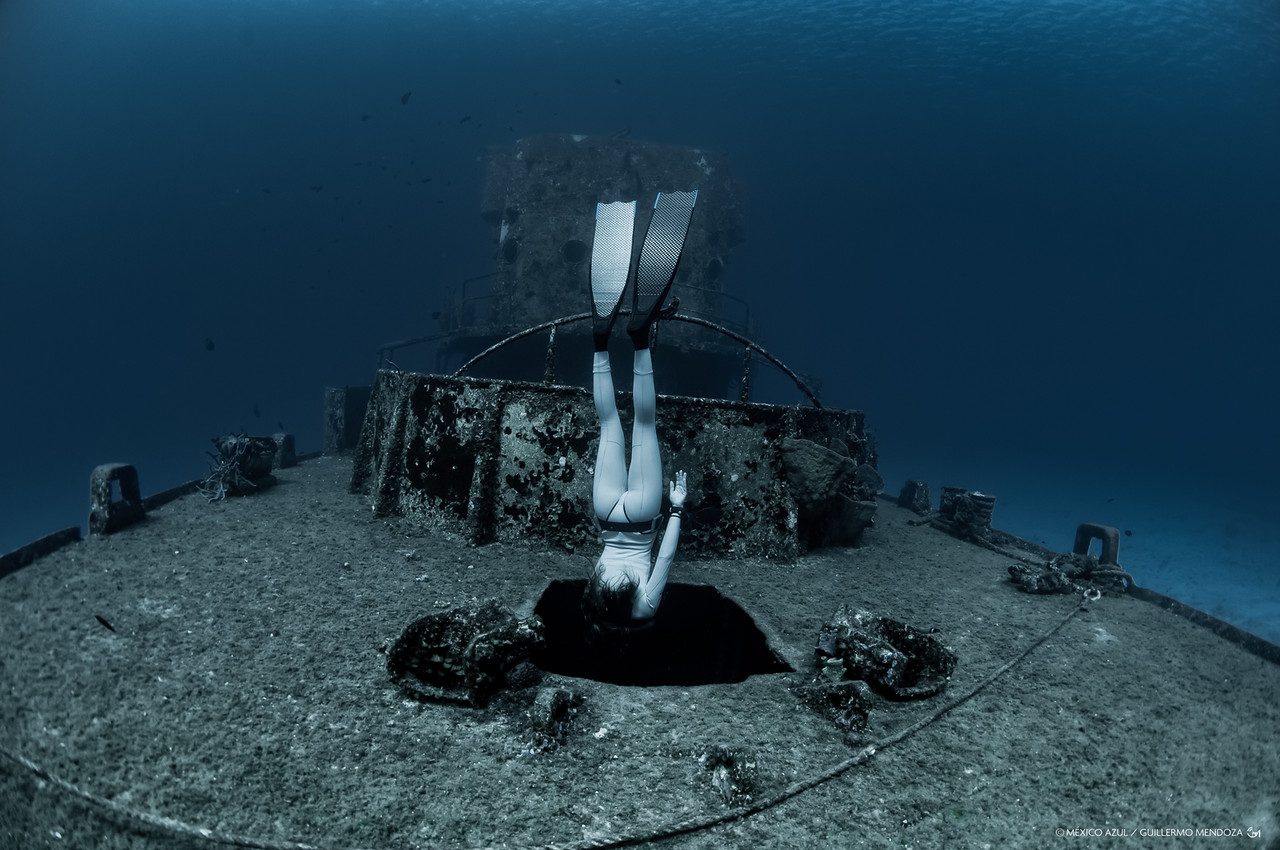
AIDA 3  – Freediving Intermediate-Advanced Course

In this post you will find all the information you need about the Freediving Beginner Course.

AIDA3 Guidelines v3.1

Freefall Academy AIDA 3 Freediving Course Approach

The AIDA 3 Freediving Course can technically be completed in three days. However, we believe that squeezing all the necessary information and practice into such a short timeframe can be challenging. That’s why we have chosen to teach our AIDA 3 course over four days. This allows us to cover the same topics and exercises without rushing, giving you ample time to absorb the material. One of the things that sets us apart from other schools is our emphasis on optimal conditions. That’s why we exclusively offer Freediving Courses from May through November, as these months provide the best weather and conditions in La Paz and its surrounding areas. During this time, the wind is typically calm, the water is warmer, and visibility is significantly improved. In addition to prioritizing favorable conditions, we differentiate ourselves by offering two days of boat-based training. While many schools conduct their courses from the shore or mix, we believe that going out on the boat enhances the experience and allows us to find the best diving spots. We strive to create an enriching and enjoyable learning environment, optimizing your freediving experience with us.

Itinerario

Día 1

9am-12pm – We’ll meet at the classroom, fill out paperwork and start the theory lesson. 12:00-12:30 – Breathing session 12:30-2pm – Static Apnea Session

Día 2

9am-12pm – Theory session and equalization workshop 12:30-2:30pm – Dynamic Apnea Session

Day 3

8:30am- Lunch stretching session 9am – Depth Sessions 2pm – Finish

Day 4

8am – Meet and transport to La Ventana 9am – Depth Sessions 2pm – Drive back to La Paz 3pm – Finish   The location of the depth sessions may change according to the weather and the logistics. The exact time and schedule may change due to logistics. The exam will be online.

Precio

$10,900 pesos per person Includes: theory manuals, pool fees, AIDA certification, boat fees, transportation from La Paz, freediving retal gear. 10% de descuento para mexicanos al presentar INE


Our Recommendations

To maximize your enjoyment and benefit from this course, we strongly recommend that you have a comfortable diving capability of at least 20 meters. This means being able to dive multiple times per session to that depth. The skills covered in the course are practiced within the range of 15-25 meters, with a maximum depth of 30 meters. If diving to 20 meters poses a significant challenge for you, it may hinder your ability to fully apply the new theory and skills learned during the course. In such cases, we advise you to engage in training and practice before pursuing the AIDA 3 course until you feel confident and at ease diving to the 20-meter mark. Once you have achieved this comfort level, you will be well-prepared to embark on the AIDA 3 course and make the most of your experience. We recommend that if you have your own gear to bring it in order to asure that you have a perfect fit. If you don’t have your own gear we will provide it for you. At time of booking please send us your height, weight and show size (eu).

We hope to see you underwater! If you have any doubts please contact us at apneafreefallacademy@gmail.com and we will be happy to assist you.
Read More
Posted on

AIDA 2 Freediving Beginner Course

BY: Valentina / 6 COMMENTS / CATEGORIES: Baja, Course, Freediving

AIDA 2 Star Course – Freediving Beginner Course

In this post you will find all the information you need about the Freediving Beginner Course. 

AIDA2 Guidelines v3.2Freefall Academy AIDA 2 Freediving Course Approach

The AIDA 2 Freediving Course can technically be completed in three days. However, we believe that squeezing all the necessary information and practice into such a short timeframe can be challenging. That’s why we have chosen to teach our AIDA 2 course over four days. This allows us to cover the same topics and exercises without rushing, giving you ample time to absorb the material.

One of the things that sets us apart from other schools is our emphasis on optimal conditions, especially for beginner freedivers. That’s why we exclusively offer Freediving Courses from May through November, as these months provide the best weather and conditions in La Paz and its surrounding areas. During this time, the wind is typically calm, the water is warmer, and visibility is significantly improved.

In addition to prioritizing favorable conditions, we differentiate ourselves by offering two days of boat-based training. While many schools conduct their courses from the shore or mix, we believe that going out on the boat enhances the experience and allows us to find the best diving spots. Furthermore, on the final day of the course, we usually teach in La Ventana, where after our freediving session, we make the most of our time by engaging in fun dives, where you can apply your training without the use of a line.

We strive to create an enriching and enjoyable learning environment, optimizing your freediving experience with us.


Itinerario

Día 1

9am-12pm – We’ll meet at the classroom, fill out paperwork and start the theory lesson.

12:00-12:30 – Breathing session

12:30-2pm – Static Apnea Session

Día 2

9am-12pm – Theory session and equalization workshop

12:30-2:30pm – Dynamic Apnea Session

Day 3

8:30am- Lunch stretching session

9am – Depth Session 

2pm – Finish

Day 4

8am – Meet and transport to La Ventana

9am – Depth Session and fun dives

2pm – Drive back to La Paz

3pm – Finish


The location of the depth sessions may change according to the weather and the logistics.

The exact time and schedule may change due to logistics.

The exam will be online.


Precio

$8,950 pesos per person 

Includes: theory manuals, pool fees, AIDA certification, boat fees, transportation from La Paz, freediving retal gear.

10% de descuento para mexicanos al presentar INE


Our Recommendations

To fully enjoy this course, we recommend that you are confortable in the water. Prior freediving experience is not required, but definitely being able to comfortably swim and/or snorkel. If you don’t have any experience swimming and/or snorkeling we recommend that you take the AIDA 1 Discover Freediving Course.

We recommend that if you have your own gear to bring it in order to asure that you have a perfect fit. If you don’t have your own gear we will provide it for you. At time of booking please send us your height, weight and show size (eu).


We hope to see you underwater! If you have any doubts please contact us at apneafreefallacademy@gmail.com and we will be happy to assist you.
 

Read More
Posted on

AIDA 1 Freediving Discovery Course

BY: Valentina / 2 COMMENTS / CATEGORIES: Course, Freediving, Sea Lions, Snorkeling

AIDA 1  – Freediving Discovery Course

In this post you will find all the information you need about the Freediving Beginner Course.


Freefall Academy AIDA 1 Freediving Course Approach

The AIDA 1 Freediving Course can be completed in one or two days. The option 1 is done in 1 day, where we cover the theory and static apnea. The option 2 is done in 2 days, where we cover theory, static apnea and depth.

One of the things that sets us apart from other schools is our emphasis on optimal conditions, especially for beginner freedivers. That’s why we exclusively offer Freediving Courses from May through November, as these months provide the best weather and conditions in La Paz and its surrounding areas. During this time, the wind is typically calm, the water is warmer, and visibility is significantly improved.

In addition to prioritizing favorable conditions, we differentiate ourselves by offering the depth session boat-based . While many schools conduct their courses from the shore, we believe that going out on the boat enhances the experience and allows us to find the best diving spots. 

We strive to create an enriching and enjoyable learning environment, optimizing your freediving experience with us.


Itinerario

Día 1

9am-12pm – We’ll meet at the classroom, fill out paperwork and start the theory lesson.

12:00-12:30 – Breathing session

12:30-2pm – Static Apnea Session

Día 2

8:30am- Lunch stretching session

9am – Depth Session in La Paz

2pm – Finish


The location of the depth sessions may change according to the weather and the logistics.

The exact time and schedule may change due to logistics.


Precio

Option 1 – $4,200 pesos per person 

Option 2 – $6,300 pesos per person 

Includes: theory manuals, pool fees, AIDA certification, boat fees, freediving retal gear.

10% de descuento para mexicanos al presentar INE


Our Recommendations

We recommend that if you have your own gear to bring it in order to asure that you have a perfect fit.


We hope to see you underwater! If you have any doubts please contact us at apneafreefallacademy@gmail.com and we will be happy to assist you.
 

Read More
Posted on

Freefall in Freediving

BY: Valentina / 0 COMMENTS / CATEGORIES: CNF, Freediving, Freefall

What is freefall in freediving?

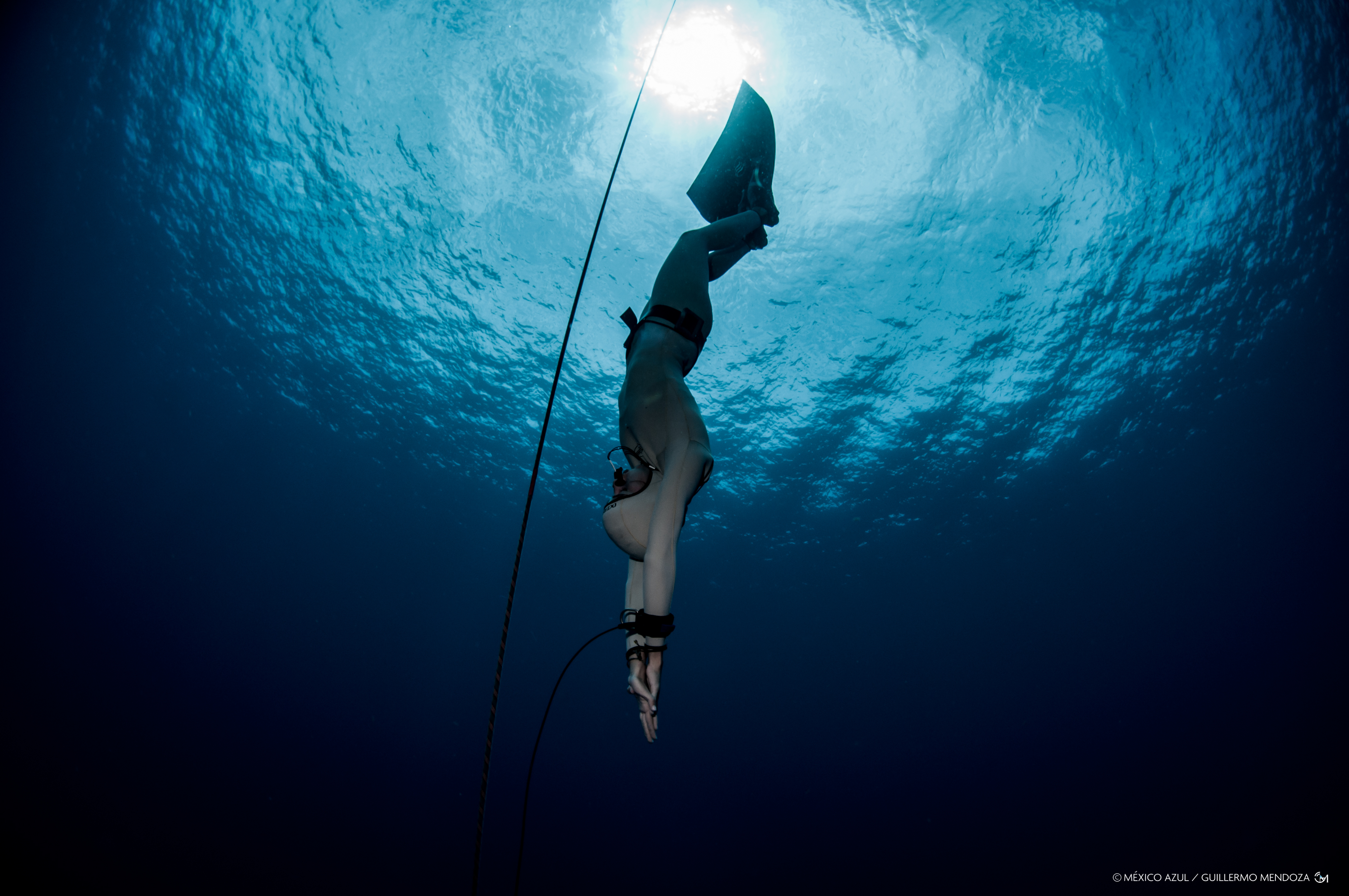
The practice of freefall in freediving occurs when a free diver reaches a point of negative buoyancy and stops finning or swimming downward, allowing the force of gravity alone to draw the diver deeper.  

Why do we freefall?

Freefall in Freediving (CNF) - William Trubridge
CNF World Record holder William Trubridge showing us how its done! Freefalling with no fins.

As a free diver descends in water, the volume of air inside of their body (therefore the volume of the body itself) becomes smaller or more compressed thereby changing the buoyancy of their body.  This is explained by Boyle’s Law . Archimedes’ principle respectively.

Every free diver possesses a different degree of buoyancy which is variable to their freediving gear (i.e. wetsuit, weight belt, fins, mask, etc.).  A safe freediving practice is to have a positive buoyancy of at least 10 meters because most of the blackouts happen between 10m and the surface.  This way, if a blackout does occur, the diver will float to the surface, making a rescue more achievable.  We will discuss more safety protocols in a different blog post.  

The freefall is a technique used by almost every professional free diver.  This is because, during the freefall the diver is not required to use physical exertion to gain distance in depth.  This allows the diver to conserve oxygen and energy while decreasing the rate of carbon dioxide production.  The freefall can be likened to a depth static, where the individual can focus her or his consciousness on relaxation and equalization.   

Freefall Technique

Freefall in Freediving with bi-fins
Freefall in freediving with bi-fins (fins are parallel to the line and knees are slightly bent).

That being said, there is a proper technique to the freefall.  When mastered freefall can lead a free diver into a dream-like or zen-like state.  In general, the ideal body position will be as hydrodynamic as possible.  Specifically, the head should be in a neutral position to aide in equalization, neither looking down or up the line. The torso parallel to the line. The arms and hands should be streamlined along the side or front of the body.  Without fins the legs should be straight with pointed feet, or slightly bent legs with relaxed feet.  With fins, the legs should be slightly bent from the hips or knees so that the blade(s) of the fin(s) run parallel with the line (like in the picture).

A good technique will yield a freefall rate of approximately one meter per second (1m/s).

Personal Preference

While in freefall the free diver has the option to close their eyes, this furthers the relaxation and therefore oxygen conservation.  The current CWT (Constant Weight) world record holder Alexey Molchanov while in freefall has said he only opens his eyes slightly every few seconds.   He does this to make sure he has good positioning along the line.  Other divers, such as Alenka Artnik, the CWT Roatan 2017 AIDA World Champion freefalls with her eyes closed the entire time and feels the line with her hand.  There are many slight variations that are a personal preference for each individual free diver.  

In conclusion, the freefall is a very useful and peaceful practice to improve relaxed gains in depth while freediving.  It is personally our favorite part of freediving, hence the name ‘Freefall Academy’. We hope you have learned something from this post.  Please share an experience or thought with us below in the comment section.  Or better yet, come freefall with us in one of our courses here in La Paz. Safe freefalls. 

Check out this amazing video of Guillaume Néry freefalling at Deans Blue Hole in Bahamas!

Read More
Posted on

Espiritu Santo Island and Sea Lions

BY: Valentina / 0 COMMENTS / CATEGORIES: Espiritu Santo, Freediving, Sea Lions, Snorkeling

Espiritu Santo Island

A little bit about the habitat of Espiritu Santo Island

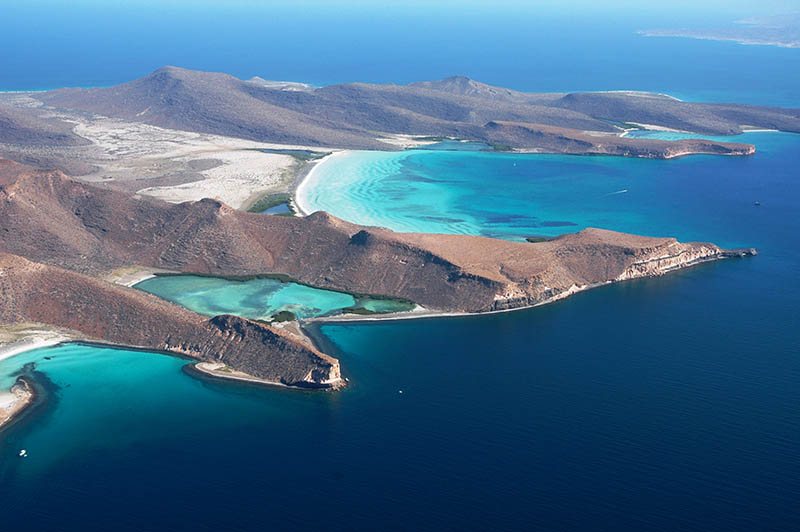
Espiritu Santo Island is without a doubt one of the most beautiful places on Earth. It has scenic mountain ranges reaching a maximum altitude of 1200m, extraordinary cliffs made from volcanic stone and pristine white sand beaches.  The amazing water colors, ranging from green turquoise, to deep and transparent blue gives a feeling of tranquility to the soul.

It is a perfect place to experience snorkeling, freediving, scuba diving, hiking, kayaking, camping, stand-up paddle boarding and sailing.

Espiritu Santo Island is apart of the Archipelago of Espiritu Santo, which became a National Park in 2007. Espiritu Santo Island is located in the Gulf of California, North of La Paz, Baja California Sur.  Furthermore, it became an UNESCO World Natural Heritage Site in 2005 along with 243 other islands, islets and coastal areas in the Gulf of California.  These areas contain 39% of the world’s total number of species of marine mammals and a third of the world’s marine cetacean species.

In addition, the island contains many habitats, such as mangroves, sandy bottoms, rocky reefs, estuaries, beautiful isolated beaches and bays. It’s perfect for all kinds of people, from little kids who want to start exploring the underwater world, to experienced divers that would like to see why the Sea of Cortez is called the “aquarium of the world”.

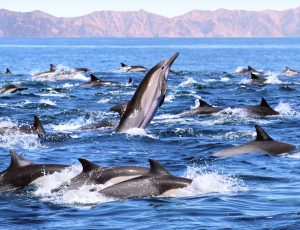
A group of common dolphins in BCS

The Flora and Fauna

Espiritu Santo Island has 38 species of plants and animals that are unique (or endemic) in the whole World.   The juancito, the babisuri, the black hare and the sandy snake are examples. Furthermore, there are 200 species of plants and more than 70 species of animals (not counting the ones underwater).

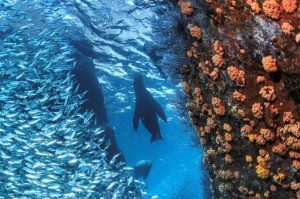
As you submerge before the surface you can find at least 15 species of marine mammals, including dolphins, whales and the famous colony of sea lions.  In addition, you can find more than 50 species of aquatic birds gracing the waters, airways and cliffs.

Sea Lions of Espiritu Santo Island

The Sea Lions that live in the islets called “Los Islotes” or “La Lobera” are a species scientifically called Zalophus californianus.

A big group of Sea Lions at “La Lobera”

As well as other marine mammals, sea lions are very curious. This attitude has to do with exploration and playing. The young ones are especially playful; they might even play with your fins or other “weird” equipment. Think about a cute little puppy, then put it underwater, let it evolve and you will have a beautiful playful sea lion.

These beautiful creatures are on the island all year around. Los Islotes contain about 500 sea lions every year. The reproduction season initiates with the birth of the pups at the end of May.  Continuing with the breast-feeding and mating time around June, July and August.

Don’t miss the opportunity to swim or dive with these beautiful animals in Espiritu Santo Island. Check out our tours here.

Read More

This website stores cookies on your computer. These cookies are used to provide a more personalized experience and to track your whereabouts around our website in compliance with the European General Data Protection Regulation. If you decide to to opt-out of any future tracking, a cookie will be setup in your browser to remember this choice for one year.

Accept or Deny

es_MXEspañol de México
1
Escanea el código